Accreditation is often pictured as a moment — the day a provider is approved. But the deeper purpose of accreditation is not a moment at all; it is a habit. Real accreditation standards are designed to build continuous quality improvement into how a provider operates, so quality is not achieved once and displayed forever, but maintained and raised over time. This guide explains how standards and continuous improvement fit together, and how providers can embed both.
What accreditation standards actually cover
Robust healthcare education standards span the full lifecycle of education. They address governance and leadership, ensuring the organization is soundly run and accountable for quality. They address curriculum, requiring clear learning outcomes, current evidence-based content, and formal review. They address faculty, expecting appropriate qualifications and ongoing development. They address assessment, demanding validity, reliability, and fairness. They address learner support and safeguarding. And, crucially, they address outcomes and improvement — whether the provider measures results and acts on them.
Notice the shape of this: strong standards are not a checklist of inputs but a description of a functioning quality system. Meeting them means running your organization well, not merely assembling paperwork.
Why continuous improvement is the heart of it
Of all these domains, continuous quality improvement is the one that determines whether the others stay healthy. A curriculum that is excellent today drifts out of date without review. Assessment that is valid now degrades without moderation. Faculty skills need refreshing. Continuous improvement is the mechanism that keeps every other standard alive. That is why credible accreditors weight it so heavily: it predicts the future, not just the present, of a provider’s quality.
The improvement cycle in practice
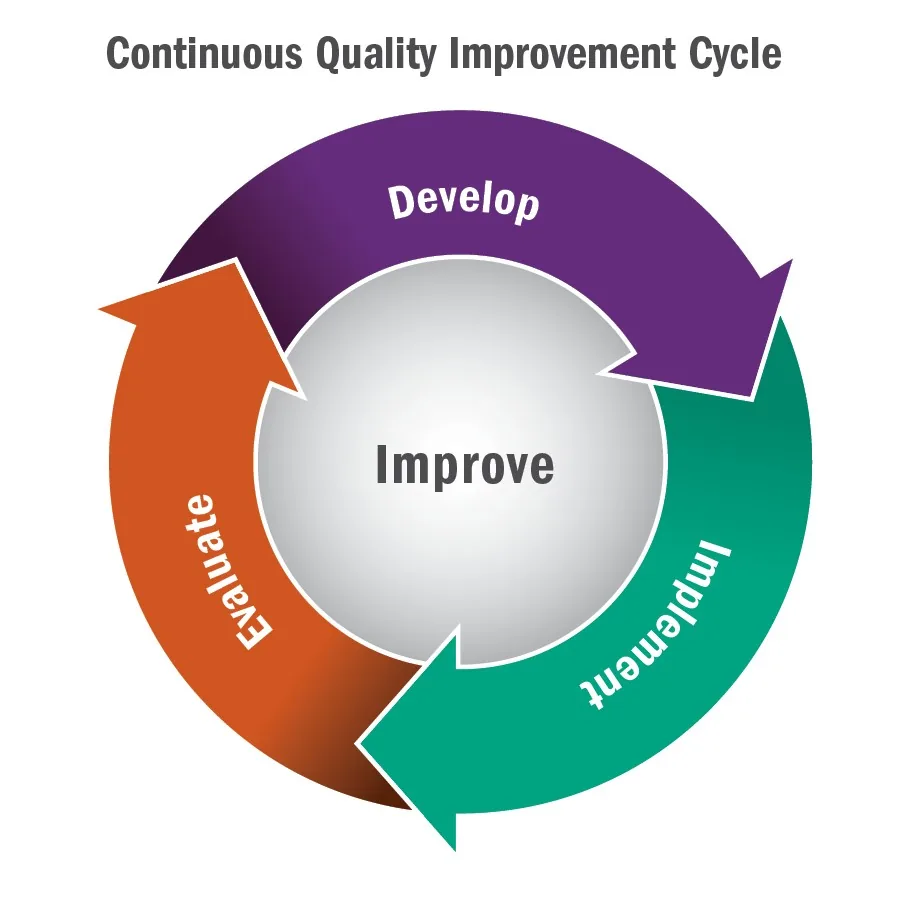
Continuous quality improvement is usually expressed as a cycle: plan, act, review, improve — then repeat. In an education provider, that looks like setting quality goals, delivering education, gathering evidence about how it went (completion, achievement, learner feedback, outcomes), reflecting honestly on what that evidence shows, making changes, and then checking whether the changes worked. The specifics matter less than the discipline: a genuine, regular, evidence-driven loop rather than an annual formality.
Turning standards into a living system
Providers who thrive under accreditation stop treating standards as an external test and start treating them as the design specification for how they operate. Governance standards shape how they make decisions. Curriculum standards shape how they build and review courses. Improvement standards shape their calendar of reviews. When standards are internalized this way, accreditation stops being something done to the provider and becomes something the provider simply is. Reaccreditation then becomes straightforward, because nothing had to be manufactured for the occasion.
Evidence: the connective tissue
Both standards and improvement depend on evidence. You cannot prove you meet a standard without it, and you cannot improve without measuring. Providers should build the habit of capturing evidence as a byproduct of normal work — documented reviews, assessment data, feedback, outcome tracking — rather than scrambling to assemble it before an evaluation. Good evidence practices make accreditation easier and improvement real.
The role of outcomes
Modern standards increasingly focus on outcomes: not just what was taught, but what learners can do afterward, and whether the education made a difference. This orientation pushes providers to ask harder, more useful questions. Are our graduates actually more capable? Is our CME changing practice? Outcome-focused improvement is more demanding than tracking activity, but it is where the real value of education lives.
Building a culture, not just a process
The providers who sustain quality over many accreditation cycles have something beyond documented procedures: a culture where improvement is expected and psychologically safe. When staff can raise problems without blame, weaknesses surface early and get fixed. When leadership visibly acts on feedback, everyone takes quality seriously. Standards and cycles provide the structure, but culture is what makes them run when no evaluator is watching — which is, after all, most of the time.
Frequently asked questions
What is continuous quality improvement in simple terms?
It is a regular cycle of setting goals, delivering, measuring the results, reflecting on them, and making changes — then repeating. It keeps quality from drifting and steadily raises it over time.
Do we need special software for continuous improvement?
No. The discipline matters more than the tools. A simple, consistently used cycle with documented evidence beats sophisticated software that no one actually maintains.
How is this different from just passing accreditation once?
Passing once shows quality at a single moment; continuous improvement sustains and raises it. Credible accreditors weight improvement heavily because it predicts whether quality will last after the decision.
The takeaway
Accreditation standards and continuous quality improvement are two halves of one idea: define quality clearly, then keep raising it. Providers who embrace both do not just pass accreditation — they build organizations that get better every year.
AIHCM accredits healthcare education providers against internationally recognized standards built around continuous quality improvement, and enables them to issue globally verifiable digital credentials — so quality that is real inside your organization becomes trust that is visible outside it.
Build on internationally recognized accreditation standards.
Explore accreditation